Civil and Environmental Engineering
629 Davis Hall
University of California, Berkeley, CA 94720-1710
e-mail: hermanowicz@ce.berkeley.edu
Contact (.vcf) 
SELECTED PROFESSIONAL EXPERIENCE
EDUCATION

PAST RESEARCH
Our research involves water quality treatment processes. These take a long time and I do not accept short-term (less than one year) visitors or interns in my lab. The learning curve is too steep.
Water Start-ups Entrepreneurship with Peiyuan Liu and Professor Yuxiong Huang
We collected and analyzed data including the founding date, service area, service provided, details of funding raised, revenues and consumer responses on 132 water startups founded between 2008 and 2018 in California, USA. Our results indicated that municipal area services dominated the emerging water startup market compared with agricultural and industrial areas, and that many of the services provided were changing from conventional technologies to digital technologies. Though the current revenues of digital water startups were low, they hold the promise of overall social benefits.

Deammonification of Anaerobic Sludge Digestate
We are focusing on inhibitiory factors in this process that includes
nitritation by ammonia oxidizers (AOB) and further production of
di-nitrogen by anammox bacteria. Yuan Li and Zaoli Gu were leading this
effort.

Better Drinking Water Quality in Storage
Dr. Kinga Skalska (a visiting scholar from Poland sponsored by the
Kosciuszko Foundation) studied application of
UV and mixing devices to improve water quality in storage tanks.
SOAP for GRIT ( Solar Optics-based Active Pasteurization for Greywater Reuse and Integrated Thermal Building Control) (more details - a lot of people in my lab including Henry Kagey and Vivek Rao
A joint project with Paz Gutierrez (Architecture)
and Luke Lee (Bioengineering) and students and researchers from environmental
engineering, building science, and bioengineering.
We were awarded a
$2 million
National Science Foundation (NSF) grant for research on
biologically-inspired technologies for grey water reuse and thermal
energy management that may propel sustainable building into a new era.
We are looking at utilization of solar energy for disinfection,
photocatalytic oxidation of pollutants, and thermal energy capture in
the facades of tall buildings using advanced microoptics. The
interdisciplinary work involves
developing material decision support framework, numerical simulation,
and experimental work on photocatalytic oxidation and disinfection.
More details in this NSF video

Basic concept of an active facade in a building

Evolution of velocity and temperature in our simulations


Biofilm Architecture in a Novel Reactor - Wei Jiang and Lian Duan
A project funded by Grundfos involves examining biofilm architecture
(structure and morphology) in a reactor with well-defined mechanical
shear.

An amazing multilayer biofilm structure seems to develop and we making
progress in understanding how it happens and how it affects reactor
performance.

Physics of Foaming in Anaerobic Digesters - Allyson Lutz (and Dr. Chanhyuk Park in the past)
Foaming in anaerobic digesters has been identified for over a decade
with severe impacts on the overall digestion process. Digester foams
have been known to top and overflow floating covers on digesters, foul
gas collection systems, and invert total solids (TS) profiles within
digesters.
Some digester foams can form stable layers that occupy a significant
volume of the digester. In collaboration and support of the San Francisco PUC - Wastewater Enterprise
we are studying the physics of foaming with the goal of better understanding foam evolution, its stability and collapse.
Sustainable Development: Physical and Moral Issues
Sustainable development gradually becomes an important concept
embedded in many societal activities including economy, politics and
perhaps even regulations.
Sustainability is now a growing concern of businesses, governments,
civic groups and individuals. These concerns are often linked to energy
efficiency,
reduction of environmentally harmful emissions, ecosystem preservation
and other “save the Earth” efforts.
They are becoming a part of a “triple bottom line” for business
accounting: financial, social and environmental.
Despite its increasing importance, current definitions of
“sustainability” are somewhat vacuous.
This paper presents a possiblity to characterize sustainability in
terms of system theory and chaotic dynamics with strong links
to moral and ethical issues.


New Sources of Water
The overarching issue in water science and engineering is to meet the
demand for water while at the same time maintaining an ecological
balance.
Through human history access to water was one of the major factors
controlling growth and development.
While water is an essential element of life, access to it, or really the
lack of access, is not only a moral issue.
Poor water supply degrades public health, stunts economic development
and even affects the level of education.
New solutions to growing water demands will usually consist of water
management, water conservation and education, financial tools, and
technology.
A model for such creative involvement of scientists, engineers and
policy makers already exists by linking private and public resources.
Toward a Definition of Sustainability
funded (in the past) by the UCB Bridging Grant
The main goal of the proposed project is to advance the development of a
quantitative measure of sustainability that can be used for rational
decision-making process in the water management field.
The specific objectives are:
- to evaluate an entropy-based measure applied to unit processes and operations
- to investigate inclusion of information content in such a measure
Water reuse
Water reuse in many part of the world is becoming a vital element water management.
Reclaiming and repurifying water for subsequent reuse reduces an overal demand for water,
enhances stability of water supply and its local control, and may protect vulnerable ecosystems.
One example of our work focuses on institutional, economic
and energy aspects of water reuse.
Also, a working paper on water scarcity and water reuse drivers
Submerged Membrane Bioreactor Performance And Solids Processing
sponsored by Water Environment Research Foundation
and Zenon Corporation
We are investigating the phenomena of increasing filtration resistance at both high and low MLSS
concentrations. We postulate that at high solids concentrations the increase of
filtration resistance is mainly related to high bulk viscosity of the biosolids suspension.
At low MLSS (and corresponding low SRT) the increase of filtration resistance is likely
to be caused by exocellular macromolecular compounds produced by microorganisms that may
or may not significantly change biosolids viscosity. We are also looking into the the reasons
why MBR and conventional system activated sludge behave differently with respect to membrane
filtration.
A second research objective is to examine the behavior of MBR waste biosolids,
compared to conventional waste biosolids in solids treatment processes
such as thickening by gravity, dissolved air flotation, centrifuge and gravity belt,
and dewatering of anaerobically digested waste biosolids + primary sludge mixtures
by belt press filtration and centrifuge.
Development of biofilm structure
Recent advances in confocal laser scanning microscopy have made it possible to examine
the internal structure of biofilms in a nondestructive way. Apparently biofilms are not
homogeneous and contiguous, as previously assumed, but are often full of
holes and channels connected to the bulk liquid.
The objective of this work was to develop a procedure based on the principles of
fractal geometry for quantification of biofilm structure. Two geometric scales with different
fractal dimensions were identified in the biofilm. Small scale biomass clusters
(< 5 mm) had fractal dimensions close to the topological dimension
while the fractal dimensions of larger aggregates were considerably smaller.
Anisotropic morphology was also detected by the difference of fractal dimensions and was
possibly related to the direction of water flow. Currently, we are continuing to develop a
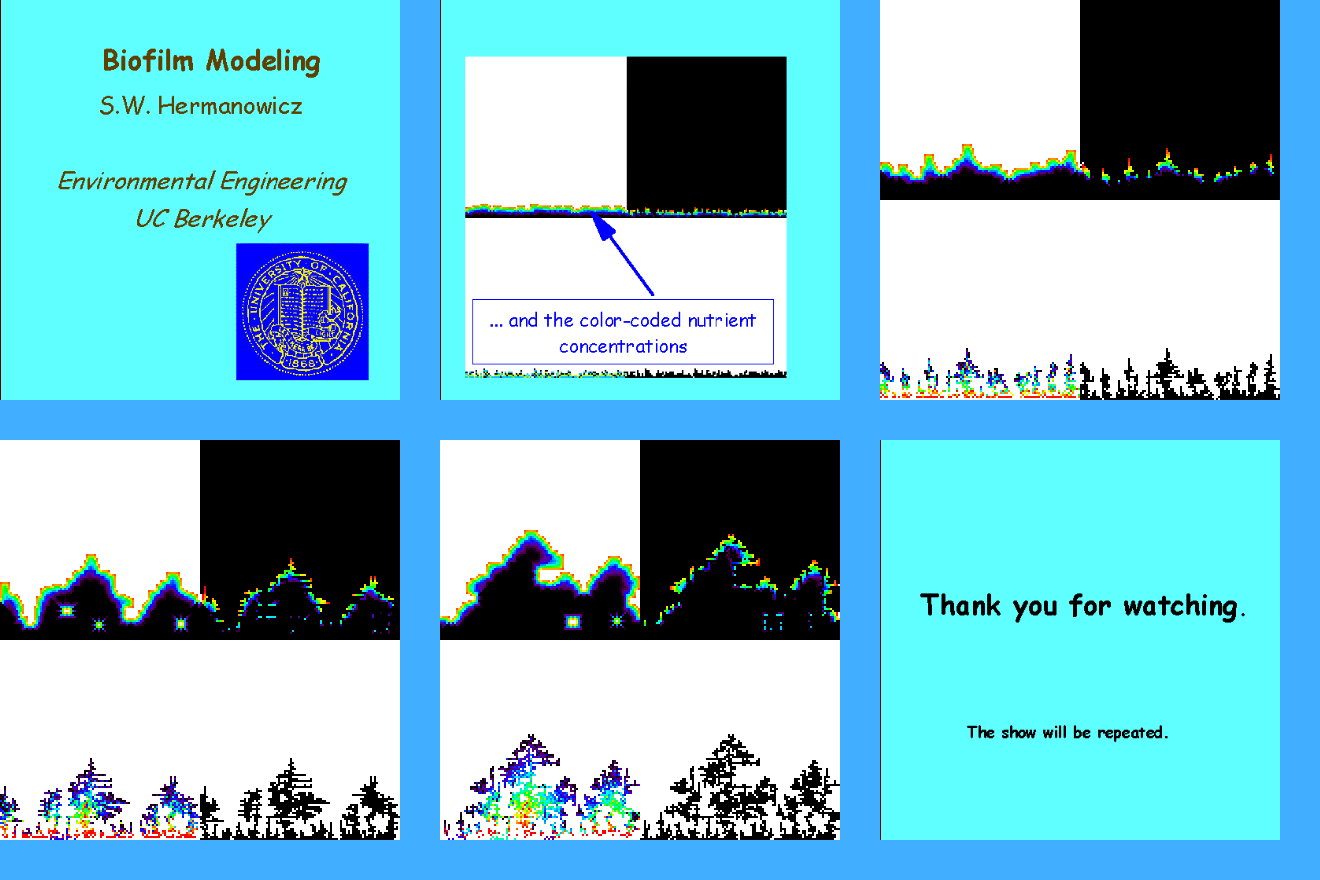
cellular automata model for the biofilm development
(see a paper in Mathematical Biosciences or
animation -1MB download;
make sure that animations are enabled on your browser).